Wednesday, May 14, 2014

The Secret Lives of Dresses by Erin McKean


I know I have probably mentioned this many times already, but I really love my local library, especially their book sales.  At the most recent sale I picked up The Secret Lives of Dresses by Erin McKean.  It is a sweet little book about Dora, a college student whose grandmother, Mimi, owns a vintage dress shop.  When Mimi has a stroke, Dora rushes home to help.  When she realizes there is not much she can do at the hospital, she fills her days keeping the dress shop running.  She is surprised to find that Mimi has been writing stories about many of the dresses in the shop.  Vintage clothes are something Dora knows, but that can't see herself wearing.  Unfortunately for her, she rushed to town with only the clothes on her back and so is forced to dress from the closet that Mimi has been cultivating for her for years.  As each day passes, Dora feels more and more comfortable in the beautiful clothing and she begins to change from the aimless student into a more determined, confident young woman.  

This book wasn't perfect and I would consider it more of a beach read, but I still enjoyed it.  I felt like there weren't nearly enough of the dress stories included in the book and there were a few characters that annoyed me, but overall it was good enough.  I could picture it as a film with hazy sepia-toned flashbacks for each of the dress stories.  The wardrobe would be fantastic.  If you are looking for something light to add to your summer reading list, this could be for you.

The Homesman by Glendon Swarthout


The official book club selection for May was The Homesman by Glendon Swarthout.  I'm not normally a fan of Westerns, books or movies, but that is what book club is all about- reading something different.  This particular book was named the Best Western Novel of 1988 and its film version will be released at the Cannes Film Festival later this month.  The film is directed by and stars Tommy Lee Jones along with Hilary Swank and Meryl Streep.  Knowing a movie with a cast of this caliber would soon be in theaters was another good reason to give the book a read.

Mary Bee Cuddy is a single woman attempting to make it on her own in frontier Nebraska.  She is actually doing quite well when she volunteers to transport four women who have gone insane back to civilization.  The stories of these women is heartbreaking, but life is difficult on the homestead and there are a few women each year that can't make it through the long, cold winter.  Cuddy, as she is commonly called, recruits a claim jumper to help her transport the women back to Iowa where they can be returned to their families.  

The first three-quarters of this novel really had my attention.  Cuddy is self- sufficient, determined and capable.  I love strong female characters.  The women she is helping are victims of a long, lonely winter and husbands who do not understand what they are asking of them.  I was fascinated with the female perspective of being a pioneer that this book explored, but then I was painfully disappointed when it took a turn that I felt made little sense with the characters involved.  Of course, I won't spoil it for anyone who would like to read it on her or his own, but I found it very frustrating.  When I read a book, I like to get a sense of each character's personality and if the author has done a good job developing her or his characters that should be easily done.   I find it very difficult to understand when an author, perhaps wanting to throw in a surprising twist, has a character behave in a way that is inconsistent with all that that character has done or said up to that point.  Now, I love a good plot twist as much as the next person, but a complete personality change is not the same thing.  I was disappointed and I haven't decided yet if I will see the film when it comes to my local movie theater.  Have you read it?  What did you think?

Sunday, April 20, 2014

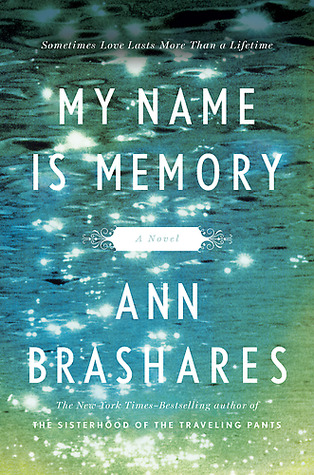
My Name is Memory by Ann Brashares


After reading The Here and Now by Ann Brashares, I was anxious to read something else by her.  Of course I have read (and listened to the audio versions of) The Sisterhood of the Traveling Pants series but that had been several years ago.  I was intrigued by My Name is Memory.  It is the story of Daniel, a young man who has a remarkable memory, so remarkable that he can remember his past lives.  Most people don't remember who they used to be, but Daniel does and he is searching for Sophia, the one person with whom he has been in love for centuries.  

As we join the story, Daniel and Sophia (as she is in her current form) are in high school.  He is unsure of how to explain the truth of reality to someone who can't possibly believe him.  The story also bounces back to Daniel's previous lives, illustrating how he has come to love Sophia and all the many lives he has spent trying to find her.  "I knew her hair and her coloring and her shapes would be different next time, but the way she wore her body would keep on."  An additional element that makes their lives difficult is the man whose sole purpose is to destroy them both.  

I loved this book.  It was interesting, exciting and  a little romantic.  Try this thought-provoking concept:

"And why can't I remember?"
"You can, more than you think.  Those memories are in there somewhere.  You act on them in ways you don't realize.  They determine how you respond to people, the things you love and the things you fear.  A lot of our irrational behavior would look more rational if you could see it in the context of your whole long life."

I enjoy historical fiction and fantasy and this book was both.  We learn about Daniel's struggles with moving from one life to another, leaving people he has known and meeting them again in another form.  The only thing I did not like about this book is that I was not aware that it was part of a planned trilogy.  It ended with a terrible cliffhanger and I was not happy to learn that the next book doesn't yet have a release date four years after the release of this one.  I do hope Ms. Brashares will continue this story as I can see it having so much potential.  And even if she doesn't, she has given my imagination quite a head start.

Monday, April 7, 2014

Still Life with Bread Crumbs by Anna Quindlen


Still Life with Bread Crumbs by Anna Quindlen was published just a little over two months ago and it was very popular on the reserve list at our library.  I think I was number 368 on the wait list!  Ms. Quindlen is the author of fifteen books, but this is the first of hers that I have read.  Still Life with Bread Crumbs features Rebecca Winter, a sixty-year-old woman struggling with her stagnant photography career, frustrations over a years-ago divorce, aging parents, and a financial situation that is less than ideal.  Rebecca rents a cottage in the woods while leasing out her expensive Manhattan apartment.  While hiking the woods, she discovers small wooden crosses that become the subject of her next project.  She also becomes involved with the people she meets in this small town.

I have to say that this isn't exactly my kind of book.  I would categorize this as chick-lit, though others may take issue with that.  A book about an older, unhappy woman attempting to "get her groove back" is just not interesting enough for me.  Am I wrong?  Did I miss something?  Tell me about it.  I would love to hear your opinions.

The Year of Learning Dangerously by Quinn Cummings


So, this school year has been one of questioning our place.  As the first year of Common Core, it has been interesting to see the way our school has had to change.  This is the fifth year at our school and we've been very happy, but as I listen to parents of older students I have wondered if this where we need to stay.  I have considered the academically rigorous charter school nearby and the more structured "traditional" charter school a little farther from home and I have also considered homeschooling.  The thought keeps occurring to me that my children can come home and do an hour or two of homework after school or we could homeschool and have the entire day's worth of work completed in just two or three hours.  When I came across Quinn Cummings' book, The Year of Learning Dangerously, I was intrigued.  I particularly appreciated the appeal of teaching "a curriculum tailored specifically" for each child.

Ms. Cummings begins by detailing the constant struggle with her daughter Alice over math.  Alice had come to the conclusion that if she didn't care for math, she could manipulate her teachers into letting her ignore it.  Because her current school wasn't working very well, she enrolled her daughter in a private school.  She was surprised to discover that this did not solve the problem and so she thought she would try her hand at home schooling.  She admits to being "highly anxious about my own qualifications to educate my kid", but she certainly puts in the effort to find the right way to do it.  

Among the advantages she lists for home schooling are these:
  • There are no bullies in homeschooling.  At home you can be eccentric and survive lunch.
  • The curriculum can, in fact, be tailored for each child's exact needs.
  • Anything you do with a homeschooled child outside the home can be described as a 'field trip'.
And of course Ms. Cummings addresses the constant concern about socialization:
  • Peer groups are an important part of social development.  But so are older people.  And babies.  And cousins you get into trouble with.  And great-aunts who make excellent pies.  And neighbors who can fix bikes.  
  • Compulsory schooling in the United States is less than a hundred and fifty years old.  It is, arguably, too soon to tell whether the peer group should be considered a developing child's best social influence.
  • How will these kids learn to deal with bullies and jerks?  As luck would have it, there are bullies at the Scout meeting, in the mall, on the playground and even at family reunions.  There are jerks everywhere.  Children who homeschool do get to negotiate with socially toxic people.  What they don't get to do is grimly endure an entire year sitting two feet away from a person who makes their lives miserable on a regular and predictable basis.  
Ms. Cummings attempts several styles of homeschooling and explores the options of many others.  She and her daughter try online state-sponsored homeschool, independent online homeschool as well as several different sources of curriculum.  She visits at "unschooling" convention, a Fundamentalist conservative Christian homeschool conference, and even tried to get a look at the Gothardite homeschool materials (those used by "their reigning first family, a perpetually smiling Arkansas couple with [as of this writing] nineteen children and 'very conservative values', who spread the gospel of a pure soul, a debt-free lifestyle and sexually segregated hairdos via basic cable").

By the end of the book, Ms. Cummings feels they have found a good solution that works well for their family.  She suggests that "American education is going to have to become smaller and more nimble, taking what resources it needs from anywhere it can get it."  She imagines a time when a high-school student may take some of her classes at the local high-school, some at the community college, some online, some from a private tutor while still receiving some instruction from a parent at home.  Why can't we design our own educational experience?  I find this method particularly compelling.  

Ms. Cummings is entertaining in her description of the journey she and her daughter took exploring the different options for homeschooling.  She is self-deprecating and at times sarcastic.  She admits her own shortcomings and looks forward to her own growth.  It is not often that I read non-fiction and this was enjoyable enough to not feel like work.  There was so much that I would have like to share here, perhaps you will read it for yourself.  


Monday, March 10, 2014

The Here and Now by Ann Brashares


When I saw that Ann Brashares had a new book coming out, I jumped right on it.  The Here and Now is a science fiction thriller where teenagers try to save the world.  Maybe that sounds a little improbable, but it's fiction and it's fun.  And it turns out it's even more than that.  I loved this book.  Prenna is a young girl who, along with a community of others, travels from the 2090s to 2010 to try to put right all the harm that has come to the environment and caused so much death and suffering.  Prenna and her community must follow strict rules to avoid causing large rifts in the future and she is content to follow these rules until she meets Ethan.  Ethan is a friend from school who seems to know that there is something different about her.  Prenna is haunted by memories of her old life and the loved ones she has lost.  She is also frightened by the feelings she is beginning to have for Ethan and the consequences of breaking the rules.  

This book appealed to me on several levels.  First, I like the idea of time travel and what one could do with such an ability.  I also like exploring what effects changing one little thing could have on the rest of time.  Secondly, I have a strong belief that one person really can make a difference in the world and so any story that follows that theme has my attention.  Mostly, however, I was strongly pulled in by the idea that the environment really could be destroyed by those of us currently living upon the earth.  The characters discuss that scientists know now what we are doing to damage the planet and they know how to reverse it, but the problem is convincing the rest of the population that it matters.  The book puts it this way:

"People here have strange ideas about what to do to help.  There is Earth Day and all kinds of green products that make people feel good- as though organic cotton sheets and hemp socks are going to do the trick.  But nobody does the hard things.  Not if it costs them anything.  Nobody calls for any real sacrifices."

One character in the book claims that his version of the future was ruined because someone felt the environment was more important than jobs and profits, but what can possibly happen to those jobs and those profits if the environment in which we live collapses?  I love when fiction takes the opportunity to make readers think about real life and his or her place in it.  That is, I believe, the true purpose of literature.

Don't Even Think About It by Sarah Mlynowski


What super power would you choose if you had the opportunity?  Flying?  Invisibility?  Telepathy?  That last one is exactly the "gift" bestowed upon a classroom full of teenagers in Don't Even Think About It by Sarah Mlynowski.  In their sophomore home class, twenty- four students sign up to get their flu shots.  One student is out sick and another refuses based on fears of unknown side effects from the shot.  She may have had a point.  It this particular batch of the vaccine, there is a mutation.  It gives each of the inoculants the ability to hear the thoughts of the people around them.  At first, each person believes he or she is hearing voices and perhaps losing their grip on reality.  As the first few figure out what is going on, they help ease their fellow classmates into the transition.  While it might be fun to hear other people's thoughts, the group soon realizes it is unnerving having their own secrets discovered.

Told in the first person plural, the characters form a group narrative.  Their opinions and thoughts merge into one that they can't help but share.  Every teen stereotype is present, but not in the annoying way one might expect.  The cover of the book is a bit cheesy, but don't let it scare you away from this very fun book.  The writing is good, it is a quick read and I would recommend it for teenagers or anyone else who enjoys YA fiction.  I can't wait to read Mlynowski's Gimme a Call.